
Rain is the weather most likely to cancel an outdoor plan, and the weather least likely to deserve it. In much of northern Europe it rains on roughly one day in three, and a family or a setting that waits for dry weather will spend a good part of the year indoors. The children we know who go out in the rain as a matter of course do not merely tolerate it: they look forward to it, because rain brings puddles, mud, worms, streams where there were none, and a landscape that smells and sounds different. The difference between a miserable wet outing and a joyful one is almost entirely clothing, plus a little knowledge about what to look for. This guide covers both, for children from two to twelve.
What rain does to a place
The first thing children notice is the smell. That earthy scent when rain hits dry ground has a name, petrichor, and a cause: bacteria in the soil produce a compound called geosmin, and raindrops striking the surface throw it into the air. Human noses are extraordinarily sensitive to it, detecting it at a few parts per trillion. Telling a child that they are smelling soil bacteria is a good way to start a wet walk.
Then there is the sound. Rain on a hood, on leaves, on a pond and on a tarp all sound different, and standing still to listen is a real exercise in attention. The land changes too. Paths become streams, ditches fill, gutters and drains turn into miniature rivers, and the whole business of where water goes, which is the water cycle in miniature, becomes visible. A child who follows a trickle from a puddle down a slope to a drain has understood a catchment.
Puddles: the physics of splashing
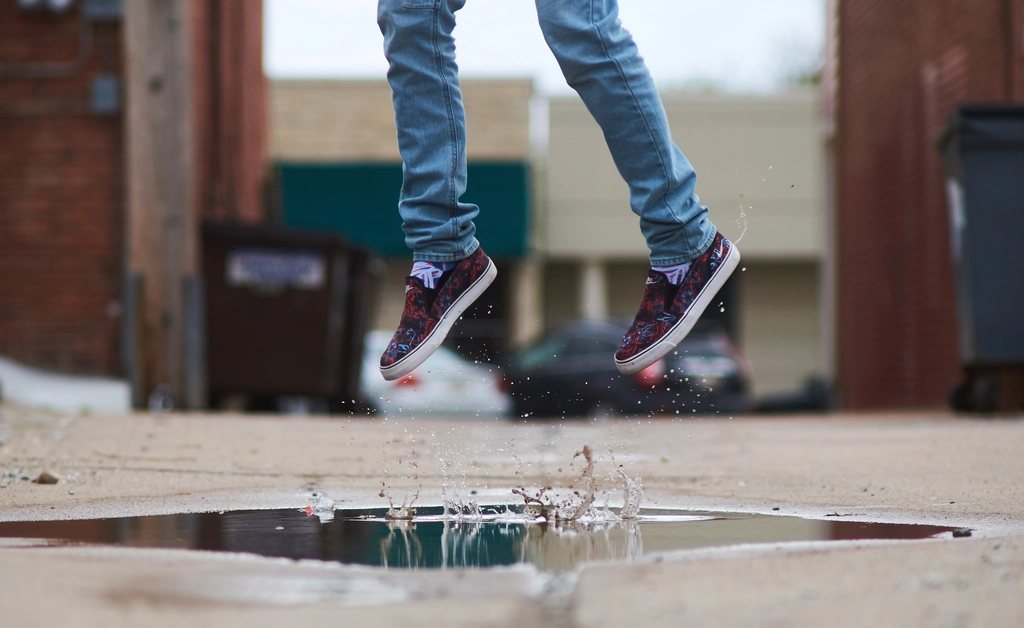
Puddle jumping is the entry point, and it deserves better than a quick splash on the way to the car. The best puddles are wide and shallow, with a hard base and no sharp edges, and a good set of them on a tarmac path or a compacted track will hold a group of three year olds for half an hour. From there the play gets more sophisticated. Which puddle is deepest? A stick marked with tape becomes a depth gauge. Where does the water go when we jump in? Why is that puddle muddy and this one clear? What floats: a leaf, a stick, a stone, a conker, a feather? Can we build a dam across the trickle leaving the puddle, and what happens upstream when we do?
Mud is the natural extension. A patch of wet earth with a few tools, old spoons, a bucket, a sieve, a couple of pots, becomes a kitchen, a construction site or a laboratory depending on the child. Mud play is messy by design; we think of the laundry as the price of admission.
Earthworms and the wet ground
Worms come to the surface in rain, and a wet pavement or lawn after a downpour can be covered with them. Why they do it is still debated. Worms breathe through their skin and can survive underwater for days if the water holds enough oxygen, so drowning is unlikely to be the reason. The current best explanation is that wet surfaces let them travel further and faster than they could through soil, without drying out, so rain is a chance to migrate. Some researchers also think the drumming of raindrops resembles the vibration of a burrowing mole, and the worms flee upwards. Children can test the vibration idea themselves by tapping the ground with a stick or a garden fork on a damp day and watching what emerges, a technique that gulls also use.
Handling worms is a first lesson in gentleness. Wet hands, a flat palm, a few seconds of looking and then back on the soil in the shade. A rescued worm moved from a path to a flower bed is a small act of care that children take seriously. A jar of soil with a few worms, kept for a day or two with a damp cloth on top and then emptied back into the garden, shows their tunnels against the glass. The bigger lesson is that worms make soil: they pull dead leaves down, eat them, and leave behind casts that plants grow in. A garden without worms would be a poor place.
Waterproofs that actually work
A wet child is a cold child, and a cold child goes home. Cotton jeans and a fleece are fine for ten minutes and a disaster after thirty. What works is a proper waterproof outer layer over warm, quick drying layers underneath. The key measure of a waterproof fabric is how much water pressure it withstands before leaking, quoted as a column of water in millimetres. Anything below about fifteen hundred millimetres is shower resistant at best; a jacket for real rain and for children who kneel and sit in wet places should be rated at several thousand, and the seams should be taped, because water finds untaped stitching within minutes. Dungaree style waterproof trousers with a bib and elastic under the boot keep the gap at the waist closed and stop the trouser riding up when a child crawls, which is why they are standard in outdoor nurseries. For the youngest children an all in one suit is simpler still.
Breathability matters for older, more active children, who will sweat in a plastic shell and end up wet from the inside. A hood that stays up is worth more than any other feature, since most wet outings end with rain running down the neck. Underneath, wool or synthetic layers dry quickly and stay warm when damp. Boots should be a size that fits a thick sock; wellingtons are not warm on their own. A full change of clothes in a dry bag, kept in the car or the setting, means a wet outing never has a bad ending.
A wet day that works
- Dress in a taped seam jacket, bib trousers or an all in one, boots with thick socks, and a warm layer underneath.
- Head for hard puddles, a sloping path with running water, or a wood where the canopy softens the rain.
- Bring a stick for depth gauging, a bucket, a sieve and a jar for worms.
- Build a dam, follow the water downhill, and turn over a stone or two for what has come out to enjoy the wet.
- Rig a tarp or find a thick tree for a dry snack, and get everyone moving again before they cool down.
- Change into dry clothes as soon as the outing ends, not when you get home.
Rain is not an interruption of the outdoors. It is one of its moods, and children who have been allowed to meet it properly, dressed for it and with time to play, come to treat a wet forecast as good news. That shift, from weather as obstacle to weather as invitation, is one of the most valuable things outdoor childhood can give.