
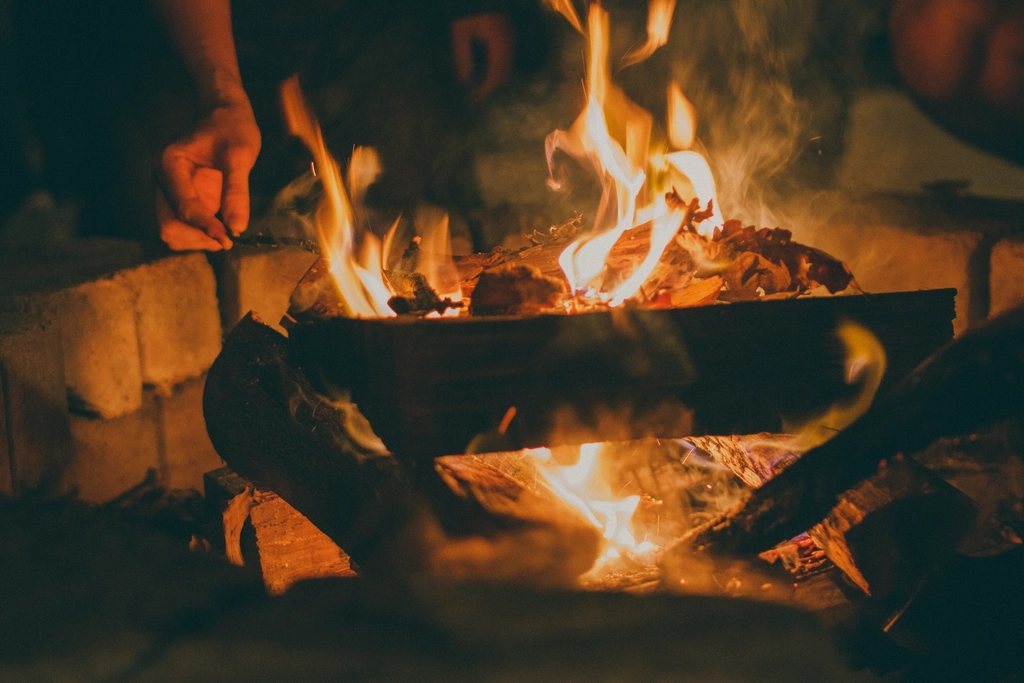
Of all the things that happen in a forest school session, fire is the one children remember. It is also the one that makes new parents most nervous, and it should, a little. Fire is a real element with real consequences, which is exactly why it is so valuable: a child who has lit, tended and put out a fire has done something genuinely serious, and knows it. The trick is not to remove the seriousness but to build a structure around it. That structure is the fire circle, and its rules are the same in most woods we know.
What follows is how we run it. If you are starting a group, treat this as a base to adapt to your site and your risk-benefit assessment, not as a substitute for training.
Building the circle before anyone lights anything
The fire circle is a physical thing before it is a set of rules. At its centre is the fire itself, small, usually no bigger than a dinner plate for a group of young children, laid on bare earth or a fire pan, inside a ring of stones or a cleared strip. Around that, at roughly one and a half metres, sits a ring of seating logs or benches. The gap between the fire and the logs is the safety zone, and nobody stands in it without a reason and a word to the leader.
Before the first session the ground is checked for roots, dry leaf litter and low branches. Fires laid over tree roots can smoulder underground for hours, so we scrape back to mineral soil. Overhead we want at least three metres of clear air. A bucket of water, a fire blanket and a first-aid kit sit at a fixed spot beside the circle, always the same spot, so that any adult can reach them without looking.
Children help build the circle in the first weeks, hauling logs and choosing stones, which does two things: it makes the boundaries visible in a way no verbal rule can, and it makes the circle theirs.
The rules, and why each one exists
Every group phrases these slightly differently, but the content is remarkably stable. We introduce them at the very first fire, and the children repeat them back before every fire after that, often chanting them, which is fine, because the point is that they know them cold.
- Walk around the outside. Nobody crosses the circle through the middle. To reach the other side you walk behind the logs. This removes almost every collision risk at a stroke.
- Enter only when asked, and only to the fire. A child who has been invited to add wood or cook steps over the log, kneels, does the job and steps back out the same way.
- The respect position. Anyone working at the fire kneels on one knee with the other foot flat. From that position you can push yourself backwards and away instantly. Sitting cross-legged or crouching on both feet, you cannot.
- Nothing goes in without permission. Sticks, leaves, plastic, food. The fire is fed only what the leader has agreed to.
- Hair tied back, loose clothing tucked. Synthetic fleece and long scarves are the usual culprits.
- Stop means stop. One agreed word from any adult ends all movement in the circle until it is lifted.
Children accept these rules more readily than adults expect. They understand that fire is dangerous, and rules that plainly serve that danger make sense to them, which is why we always explain the reason behind each one.
How a child actually lights a fire
We do not hand a five-year-old matches. The standard tool is a ferrocerium rod, a metal striker that throws a shower of sparks at around three thousand degrees when scraped with a steel edge. It cannot burn a child on its own, it works when wet, and it requires a specific, learnable technique. A child who can strike a good spark on a ferro rod has learned a real skill, not just been allowed to hold something dangerous.
The tinder that catches those sparks needs to be very fine. Cotton wool is the beginners’ choice, sometimes with a smear of petroleum jelly to lengthen the flame. From there children progress to natural tinders: the papery outer bark of birch, which burns because of its oils; dry grass; the seed heads of thistles and bulrushes; feathered sticks whittled from dead standing wood. Learning which materials catch, and why, is a season’s worth of quiet science.
The fire itself is built in stages, and children learn the three parts of the fire triangle, heat, fuel and oxygen, by seeing what happens when one is missing. Too much fuel too soon smothers the flame. Damp wood gives smoke without heat. Blowing gently from the base, not the top, brings a dying ember back. None of this needs explaining twice.
Cooking, and the point of it all
A fire that does nothing is soon boring. Cooking gives the circle a purpose and teaches waiting, which is a skill in itself. Bread dough twisted onto a green stick and turned slowly over embers, not flames, takes about ten minutes and is the first thing most groups cook. Apples wrapped in foil sit in the ash for twenty. A storm kettle, the chimney-shaped kind that boils water with a handful of twigs in the base, brings a group hot chocolate in five minutes and is often run entirely by the older children.
Fire gloves live beside the water bucket, and any child taking something off the fire wears them. The rule is simple: if you are not sure whether it is hot, it is hot.
Putting it out, and dealing with a burn
The session ends with the fire, not before it. Children pour water on slowly, stir the ash with a stick, pour again, and hold the back of a hand a few centimetres above the ground. If they feel warmth, it is not out. On sites we use regularly the fire pit is left clean and cold, with the stones in place for next time; on sites we visit once, we scatter the cold ash and replace the turf so that no trace remains.
Minor burns happen a few times a year in most groups, usually a fingertip on a hot pan. The response is the same every time and every adult knows it: cool the burn under running water for a full twenty minutes, which feels far longer than it sounds, then cover it loosely with cling film or a clean dressing. No creams, no ice, no butter. A blister larger than a coin, any burn on a face or hand joint, or any sign of the child being unusually quiet, means a trip to a doctor.
Over many years of fire circles we have seen a great many singed fingertips and a handful of blisters, and no serious injury. That record is not luck. It is the circle, the rules, the respect position and the bucket, repeated every single week until the children could run it without us. Which, in the end, is the idea.