
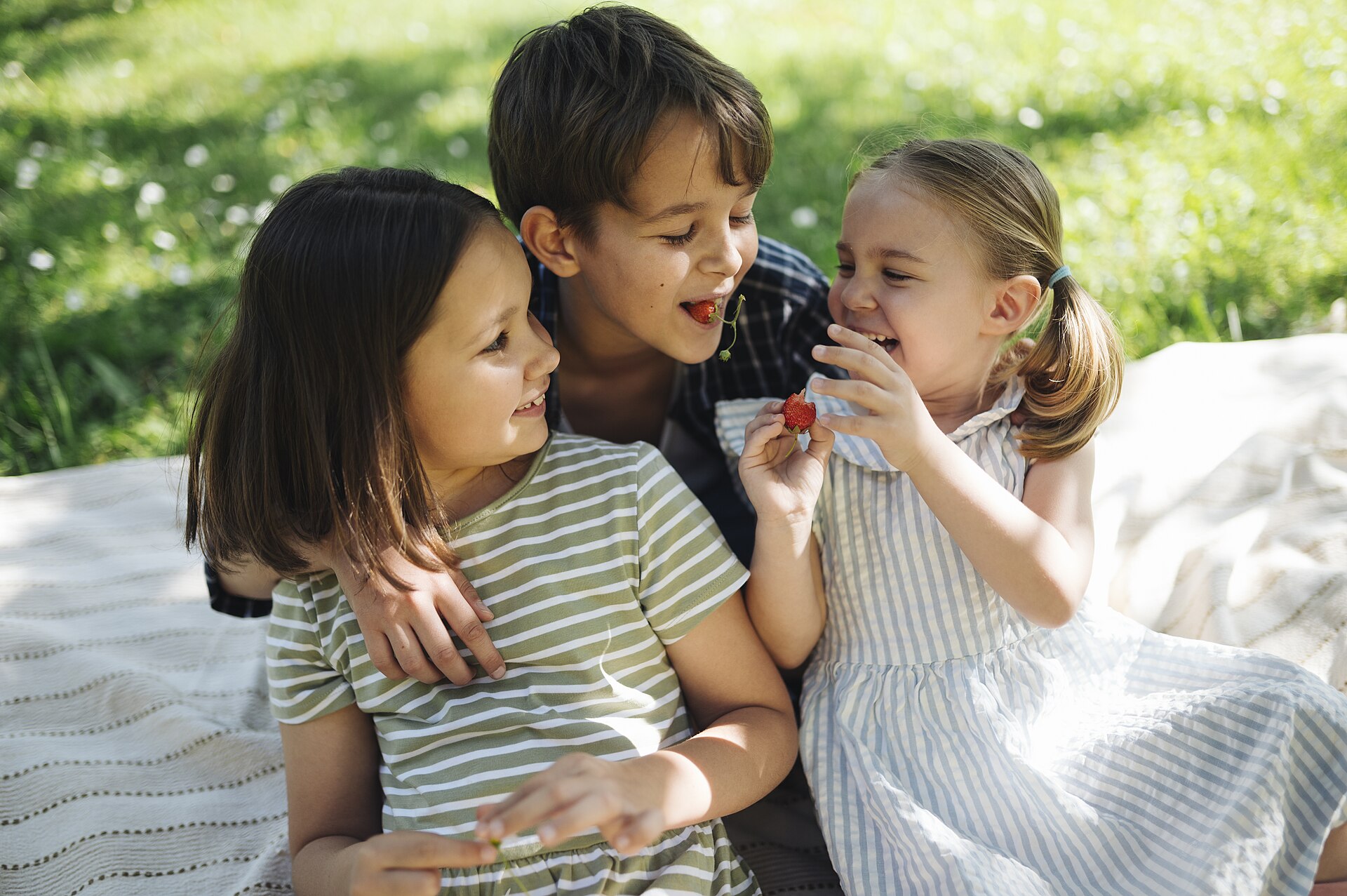
A picnic gives children something a timetabled afternoon rarely does: long, loose stretches of time with a blanket, some grass and each other. The games you reach for can shape how that time feels. This guide helps you pick games to suit the size of the group, the ground you have and the mood of the day.
- Pick a game by headcount and space first, then by age and energy.
- Alternate running games with calmer ones so nobody burns out early.
- A few small items in a bag cover most situations, and some games need nothing at all.
How do you choose a picnic game for the group in front of you?
Start with two plain questions: how many children are there, and how much room do they have? Those answers rule games in or out faster than any list can. A small garden or a corner of a park suits games where children stay close together or take turns. A wide meadow lets you use games built on distance, where players run from one side to the other.
Group size matters in a similar way. Some games only work once you have enough players to form two teams or a crowd of runners. Others fall apart if too many children wait for a turn. When a group is large, favour games where everyone is moving at once. When it is small, favour games that keep each child involved from start to finish, such as following a leader around the grass.
Age comes third, but it still counts. Younger children usually do best with rules they can explain back to you in a sentence. Older children tend to enjoy games with teams, strategy and a little room to argue over the rules. If ages are mixed, pick games where a younger child can join at their own level, and let older children take on roles such as leader or caller.
- Small space: games played in place or in a tight circle.
- Large space: games that depend on running a distance.
- Mixed ages: games with simple rules and flexible roles.
Which active and chasing games work well, and when?
Chasing games are the backbone of a lively picnic because they need almost nothing and spread easily. Tag is the plainest version: one child is “it” and chases the rest, and anyone who is tagged takes over. Freeze Tag adds a twist, since a tagged child stands still until a friend frees them by crawling through their legs. That small change gives children a reason to help one another, not just to run away.
For larger groups with plenty of room, Sharks and Minnows is a good fit. One child is the shark in the middle of the playing area, while the others try to run from one side to the other. Anyone who is tagged becomes a shark too, so the group of chasers grows as the game goes on. Four Corners also suits larger groups, with one child in the middle calling a corner while the players in that corner swap places.
Team games such as Capture the Flag and Red Rover need two sides and a good stretch of ground. They reward planning and cooperation, which older children often enjoy. Relay races are easy to scale up or down, and you can add cones or hula hoops as obstacles if the group wants more of a challenge.
Timing helps. Energetic chasing games tend to suit the start of a picnic, when children have been sitting in a car or at a desk and need to move. Food and heat change the picture later on, so keep an eye on how the group looks before starting another sprint-heavy game, especially in warm weather.
What can you play when energy drops?
Not every game needs to leave children out of breath. One child gives commands, and the others follow them only when they are prefaced with “Simon says”. It sharpens listening and is easy to run while people eat.
Follow the Leader is gentler and suits smaller groups. The leader moves around the space hopping, skipping or jumping, and the others copy. Rotate the role often so quieter children get a turn at leading as well.
Card games fit well here. A deck of cards weighs almost nothing and makes room for a child who wants a break from the crowd. Solitaire is one option for a child who needs some down time, and it can turn into a shared game when others drift over to help. Picnics and cards have a long association: the earliest English mention of a picnic links it with card-playing, drinking and conversation, which is a reminder that the quiet side of a picnic is part of its history, not an afterthought.
You can also make quiet observation rounds out of whatever is around you. Ask children to find five different leaf shapes, or to listen for three separate sounds and report back. These need no kit and give the group a breather without ending the fun.
What should you pack, and why does unstructured picnic play matter?
A small bag goes a long way. A rope, some chalk, a ball and a deck of cards cover most situations. A rope can mark a start line, serve as a boundary or become part of a relay. Chalk draws lines, corners and targets on paths and paving. A ball adds endless variations, and cards cover the quiet end of the day. Many of the classic games need nothing at all, so treat the kit as a bonus.
Improvising is part of the pleasure. Hoodies and jumpers can stand in for chairs in a game of musical chairs, for example, with the children’s own clothes laid in a circle and one removed each round. Be clear about the boundaries before play begins, point out hazards such as roads, water or sharp objects, and agree on a place where everyone gathers if you call.
It also helps to think about what picnic play is, compared with organised sport. At a picnic, children usually make up and change the rules as they go, settle disputes themselves and drift between games as interest rises and falls. There is no coach, no fixed team and no score that lasts beyond the afternoon. That looseness is where much of the value lies. Children practise negotiating, inventing and including one another, skills that a drill with a set outcome rarely asks of them.
As the adult, your best role is often to start a game, check that the rules are clear and then step back. Offer a new idea when energy flags, but resist the urge to referee every disagreement. A picnic that ends with muddy knees, a half-finished argument that was resolved by the children and a few new rules of their own invention has done its job.
Related reading
- Pond Dipping and Mini-Beast Hunts That Put the Creatures First
- Best Games for Children to Play Outdoors: Matching Play to Place
Sources
- 10 Fun and Free Picnic Games That Require No Equipment (funcraftskids.com, accessed 2026-11-23)
- Picnic — Wikipédia (en.wikipedia.org, accessed 2026-11-23)
Photo: Children enjoy a sunny picnic in a grassy park while sharing snacks and laughter, by Shixart1985, CC BY 2.0 (Wikimedia Commons)