
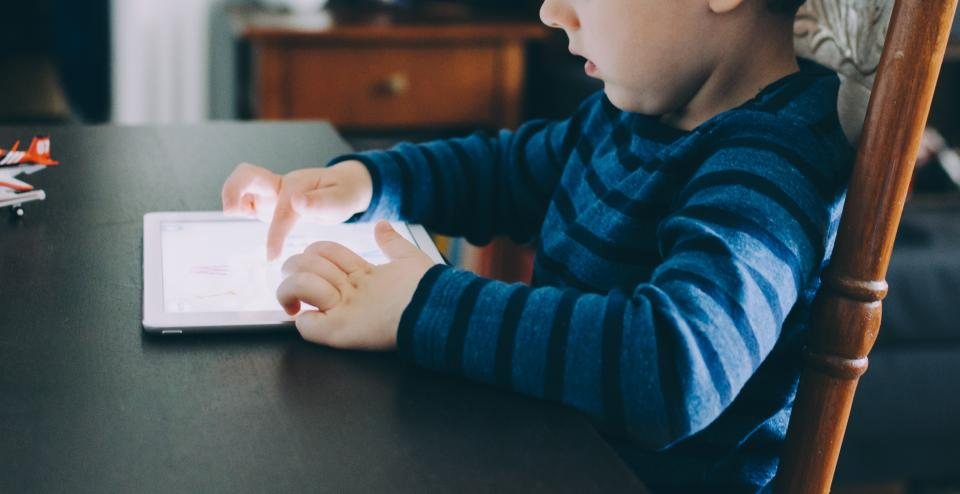
Few topics divide parents as sharply as screens. One camp treats the tablet as a babysitter that quietly steals childhood; the other points out that our own parents said the same about television, and we turned out fine. We have spent a good deal of time reading the studies behind both positions, and the honest answer sits somewhere in the middle: the evidence against screens on their own is weaker than the headlines suggest, but the evidence for time outdoors is stronger than most of us realise. The useful question is not “how bad are screens” but “what does screen time replace”.
What the guidelines say, and why they are cautious
The World Health Organization published its first guidance on physical activity, sedentary behaviour and sleep for children under five in 2019. It recommends no sedentary screen time at all for children under two, and no more than one hour a day for two to four year olds, with less being better. The American Academy of Pediatrics gives similar advice: avoid screens other than video calls before eighteen months, and keep to about an hour a day of high-quality content between two and five, ideally watched together with an adult.
It is worth noticing the reasoning behind these numbers. The guidelines are not built on proof that an extra thirty minutes of cartoons damages a developing brain. They rest mainly on the displacement argument: a toddler who is watching a screen is not moving, not handling objects, not talking with anyone and not sleeping. For a child whose whole job is to move, handle, talk and sleep, that lost time adds up.
The displacement problem is the real problem
Large surveys in North America and Europe consistently find that children aged eight to twelve now spend between four and six hours a day with screens outside school work, while daily time spent playing outdoors has fallen to well under an hour for most of them. Time is a fixed budget. When we add up school, sleep, meals, travel and homework, the hours left over are the hours in which a child either plays outside or does not.
The studies that look at screens in isolation tend to find small effects on mood and behaviour, and many of them cannot tell whether screens cause unhappiness or whether unhappy children reach for screens. But when researchers measure outdoor time directly, the results are more convincing, because they show gains rather than harms. That shift in perspective matters. We do not need to prove that screens are poison to justify a walk in the woods; we only need to show that the walk does something the screen does not.
Eyesight: the clearest evidence of all
The strongest single body of research concerns short-sightedness. Myopia has risen dramatically in East Asia over the past forty years, and rates are climbing in Europe and North America too. For a long time the blame fell on close work, including reading and, later, screens. Yet trials that reduced close work made little difference. What did make a difference was daylight.
A randomised trial in southern China, published in 2015, added one extra forty-minute outdoor class to the school day for six-year-olds and followed them for three years. Children in the outdoor group developed myopia at a rate of around thirty percent, compared with nearly forty percent in the control schools. Taiwan introduced a nationwide programme in 2010 encouraging schools to get children outside for two hours a day, and it is one of the few places where childhood myopia rates have since fallen. The mechanism appears to be light intensity: outdoor light on a cloudy day is still ten times brighter than a well-lit classroom, and bright light stimulates chemical signals in the retina that slow the eye’s excessive growth. Two hours outside per day is the figure most eye researchers now suggest.
Sleep, movement and the evening screen
The second solid strand of evidence concerns sleep. Screens held close to the face in the hour before bed delay the release of melatonin, and children who use devices in their bedroom fall asleep later and sleep less. Here the outdoors offers a double benefit. Morning daylight anchors the body clock, so children who spend time outside early in the day tend to feel sleepy at a sensible hour. And physically demanding play, the kind that involves running, climbing and carrying, produces the deep sleep that quiet indoor play does not.
Physical activity is the third strand. Children reach the recommended sixty minutes of moderate to vigorous activity far more easily outdoors than in, simply because there is room to run. Accelerometer studies show that each extra hour outside is associated with roughly seven extra minutes of moderate to vigorous movement and about thirteen fewer minutes sitting still. That is not a dramatic figure for a single day, but across a childhood it is the difference between a body that is used to effort and one that is not.
What the research does not say
We should be honest about the limits. Most studies linking screens to attention problems or low mood are correlational, and the effect sizes are often tiny. Video calls with grandparents are not the same as autoplay cartoons. Children who use screens to look up a bird they saw that morning are doing something rather different from children who scroll. And there is no evidence that a family film on a wet Sunday afternoon harms anyone.
Nor is nature a magic pill. The benefits of outdoor time depend on what children do out there. A child sitting on a bench with a phone in a park gets the daylight but not the movement. The research points towards a particular kind of outdoor time: unstructured, physically active, with things to touch, climb and investigate.
A practical way to think about it
Rather than counting screen minutes and feeling guilty, we suggest counting outdoor hours and feeling pleased. If a child has spent two hours outside, in daylight, moving about, the remaining screen time has far less to displace. Some families find it works to make the outdoors the default before screens: the walk or the garden first, the tablet after, and not in the hour before bed.
- Aim for around two hours of daylight a day, in as many short doses as the schedule allows.
- Keep screens out of bedrooms and switch them off an hour before sleep.
- Treat screens as an activity you do together where possible, not as a solo default.
- Notice what a screen is replacing on any given afternoon, and swap it out only when the alternative is better.
The research, taken together, does not tell us to fear the screen. It tells us to protect the daylight, the movement and the sleep that screens can quietly crowd out. If we get those three things right, most of the argument about screens takes care of itself.