
Summer looks like the easy season. In practice it brings its own set of risks, and they are less visible than cold: a child can overheat on a still, bright afternoon without a single complaint until they are pale and dizzy. Summer also brings the one gift no other season offers, which is light late into the evening. This guide is about making the most of that light while managing heat, sun and water sensibly for children between two and twelve.
Sun: the hours that matter
Ultraviolet radiation peaks in the middle of the day, roughly between eleven in the morning and three in the afternoon, and at those hours in June and July the UV index across much of Europe and North America is high enough to burn unprotected skin in fifteen to twenty minutes. Children’s skin is thinner and burns faster than ours, and sunburn in childhood raises the risk of skin cancer decades later, so this is not a cosmetic concern. The shadow rule is the easiest thing to teach: if your shadow is shorter than you are, the sun is strong and it is time to find shade or cover up.
Cover up means a wide brimmed hat rather than a cap, because ears and the back of the neck burn first. Loose, long sleeved shirts in light colours are cooler than bare arms in direct sun, which surprises many parents. Sunscreen with a factor of at least thirty goes on twenty minutes before going out and again every two hours and after every swim, and we put it on in the same routine as shoes so that nobody has to remember.
Shade as a place to play, not a punishment
The mistake we see most often is treating shade as the place children go when they have been told off for being in the sun. Shade should be where the good things happen. A picnic blanket under a big broadleaf tree is the base camp for a summer afternoon: the canopy of a mature oak or beech cuts direct sunlight dramatically and the air beneath it can be several degrees cooler than the open lawn. Woodland walks are at their most comfortable in July, when the leaf cover is full and the paths are dry.
If there are no trees, we make shade. A tarp strung between two poles and a fence, a bedsheet pegged over a washing line, or a pop up beach shelter turns a bare garden into a den. Children build these things with enthusiasm, and a den built at ten in the morning is used all day. We time the running around for before eleven and after four, and keep the middle of the day for slow things under cover: reading, whittling, clay, bug hunting in the shady margins where the insects also gather.
Water: cooling, playing and staying safe
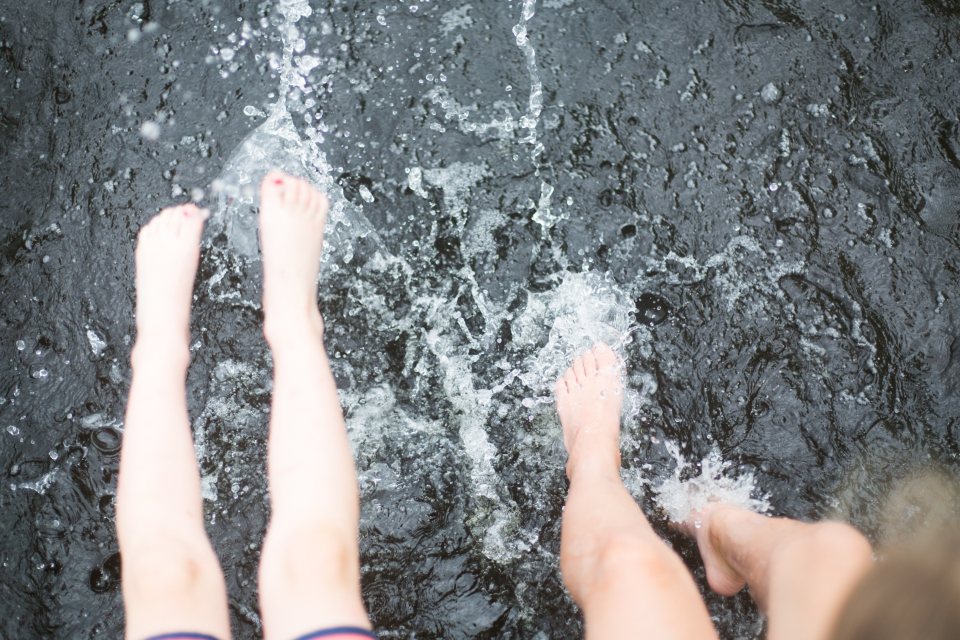
Water is the simplest way to cool a hot child and the most reliable way to keep one entertained. A paddling pool, a hose, a bucket and a set of cups, a water wall of guttering and funnels screwed to a fence, or a stream with a gravel bed will hold attention for hours. Streams offer the best learning: dams, channels, floating races, watching how a stick moves faster in the narrow part and slower in the pool.
Safety near water has one rule that does not bend. Children under five are within arm’s reach of an adult whenever they are near water deep enough to cover their face, which includes paddling pools and buckets. Drowning is silent and quick, and it happens in shallow water with adults nearby who were looking at something else for a minute. For older children swimming in lakes and rivers, we check the depth and the current before anyone goes in, we go in first ourselves, and we stay out of water below dams, weirs and bridges where the flow is unpredictable. Cold water shock is real even in July: a lake at fifteen degrees takes the breath away, and we get children in gradually rather than jumping.
Water also goes in. Children playing hard in heat can lose a great deal of fluid without noticing, and thirst lags behind need. We offer drinks every half hour rather than waiting to be asked, and we watch for the signs of heat exhaustion: flushed then pale skin, headache, nausea, unusual tiredness, irritability, and a child who stops sweating on a hot day. Any of these means shade, cool water on the skin, sips to drink and rest. A child who is confused or who does not improve within half an hour needs medical help.
Heat: reading the day
The hottest part of the day is usually not noon but mid to late afternoon, because the ground keeps warming after the sun passes its peak. On days forecast above thirty degrees we shift everything: out early, home or under cover by late morning, out again after five. Metal and dark rubber playground surfaces can be dangerously hot by early afternoon, and we check slides with a hand first. Cars parked in the sun heat to lethal temperatures within minutes, and nobody is ever left in one.
The long evenings
Around the summer solstice on the twentieth or twenty first of June, the sun sets after nine in the evening at the latitude of London, Paris or Vancouver, and twilight lingers well past ten. This is the season’s real treasure, and children’s bedtimes can flex to meet it. Evenings are cool, the UV index has collapsed, the light is beautiful and the wildlife changes shift. Bats appear at dusk over water and along woodland edges. Moths come to a white sheet lit by a torch. Hedgehogs, foxes and deer are far more visible at nine in the evening than at nine in the morning. Swifts scream around rooftops until it is nearly dark.
An evening walk at eight thirty in July, when the air smells of cut grass and the paths are empty, is a different outdoors from the crowded afternoon. Children who have napped or rested through the heat are often at their best at this hour, and the walk back in the half light does more for their confidence than a whole day in the sun.
- Plan the active parts of the day before eleven and after four.
- Hat, sunscreen and a full water bottle go on and in before leaving the house.
- Make shade the base, not the time out.
- Arm’s reach for under fives near any water; check depth and current for older children.
- Offer drinks every thirty minutes and know the signs of heat exhaustion.
- Save an evening a week for a late walk, a moth sheet or bat watching.
Summer done well is not about avoiding the sun. It is about knowing the day’s shape, using the cool hours, and letting children discover that the outdoors at dusk is as rich as the outdoors at noon, with none of the heat.