
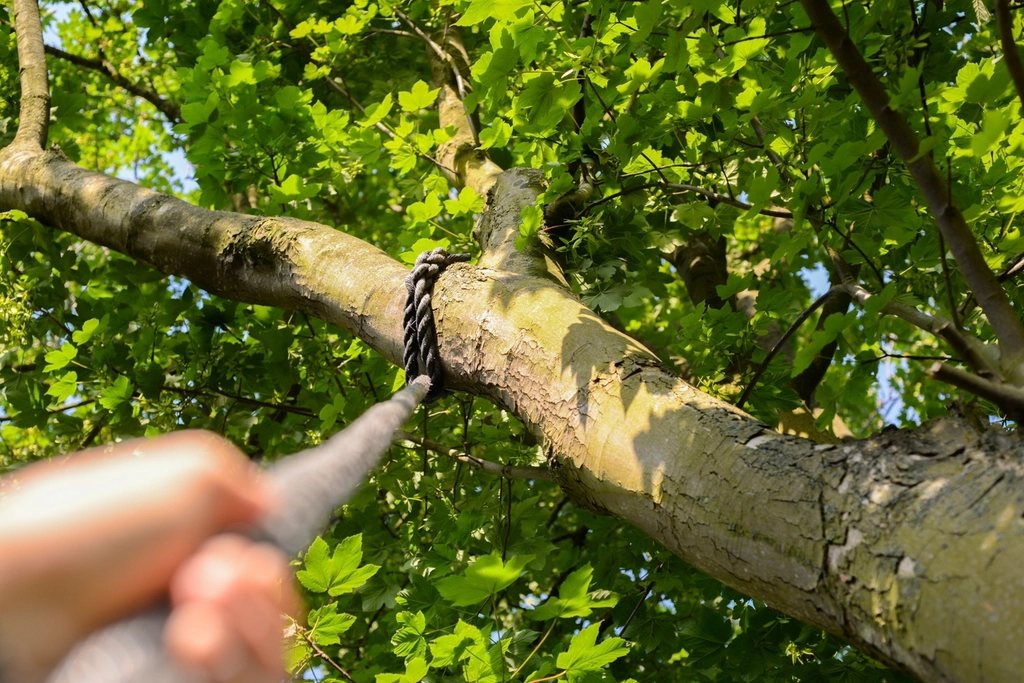
Rope is the most useful thing we carry into the woods. A few lengths of it turn a clearing into a den, a slope into a traverse, a branch into a swing, and a bored group into a busy one. Combine rope with the trees themselves, which children will climb whether or not we invite them to, and you have two of the richest parts of a forest school session. They are also two of the parts that need the most thought, because a rope swing on a bad branch or a climb on a wet trunk can hurt somebody. This is how we set them up.
What rope to bring, and how much
For general use we carry natural-fibre rope or soft polyester in two thicknesses: a handful of six-metre lengths of thin cord, around four to six millimetres, for lashing, den frames and practice knots, and two or three longer lengths of thicker rope, ten to twelve millimetres, for swings, traverses and anything that carries a child’s weight. Thin cord for small hands, thick rope for loads. Climbing rope of the kind used for roped ascents is unnecessary and, in most groups, a distraction.
Rope is checked before every session by running it slowly through the hands, feeling for cuts, stiff sections and fraying at the ends. Anything doubtful is cut down for cord or retired. Rope that has been left out in the wet loses strength, so it goes home in a dry bag, not the boot of the car.
The four knots that do almost everything
Children do not need to learn twenty knots. They need to learn a few well, so that they can tie them with cold fingers while talking to a friend. We teach the following in roughly this order, over a term or more, and we let children practise on a short length tied to their own belt loop between sessions.
- The overhand knot and stopper. The first knot every child knows. Its job is to stop a rope pulling through or to give a foot something to stand on.
- The clove hitch. Two turns around a post that grip when loaded. It starts nearly every lashing and hangs a tarp corner in seconds.
- The round turn and two half hitches. The knot for tying a rope to a tree so that it holds, does not damage the bark, and can still be undone afterwards.
- The bowline. A fixed loop that will not slip or jam. Older children learn it with the story of the rabbit coming out of the hole, round the tree and back down.
The timber hitch, the figure of eight and the square lashing come later, for those who want them. A group of eight-year-olds who can tie those four reliably can build a den frame, rig a tarp and hang a swing with very little adult help, and being able to do that is a large part of the point.
Rope swings and traverses: the anchor is everything
A rope swing is the single most popular thing we ever set up, and the whole of its safety lives in the branch. We look for a living branch of a strong species, oak, beech, ash or sycamore rather than willow, poplar or any conifer, at least as thick as an adult’s thigh where the rope goes over it, growing from the trunk at a wide angle rather than a narrow fork, with no cracks, fungus or dead wood along its length. We test it with an adult’s full weight, bouncing, before any child goes near. Then we test it again the following week, because trees change.
The rope goes over the branch with a protective sleeve, a piece of old hosepipe or folded sacking, to prevent bark damage that would eventually weaken the branch. The swing seat is a stick lashed on with a clove hitch and a stopper, or a simple loop. The landing zone below is cleared of stones and stubs, and the swing arc is walked out so that no tree, root or waiting child is in it.
A low traverse, a rope tied taut between two trees about knee height for balancing along, with a second rope at shoulder height to hold, follows the same logic: living trees, protected bark, adult-tested, cleared ground. It is a wonderful thing for four- and five-year-olds and needs only two round turns and two half hitches.
Tree climbing: the rules we actually use
We do not teach children to climb trees. They already know how. What we do is set the conditions in which they climb, and those are few and consistent. First, the tree: we identify the climbing trees on a site in advance, choosing those with low branches, sound wood and a clear fall zone, and we check them after every storm. Second, the weather: no climbing in high wind, and no climbing when the bark is wet, because a wet trunk is the most common cause of a slip.
Third, the child. Three points of contact at all times, meaning two hands and a foot or two feet and a hand. Test every branch with weight before trusting it. Climb only as high as you can climb down; if you needed help up, you will need help down, and that is the signal you have gone far enough. Younger children stay within reach of a standing adult; older ones agree a height, typically two to three metres, that we can see from the ground.
And fourth, the adult. We do not lift children into trees, and we do not talk them up higher than they want to go. We stand close, hands free, and we let them work out the route. When a child is stuck, the first thing we offer is words, not hands: where is your foot going next, is there a branch by your left knee. Most children get themselves down. The ones who do not have learned something about their limits that is worth more than the climb.
What children get from all this
It is easy to describe ropes and trees in terms of risk, and we have spent most of this piece doing so. But the reason we bother is the other side of the assessment. Knots are fine motor skill, sequence memory and the satisfaction of a thing that holds. Swings and traverses are balance, core strength and the physics of momentum, learned through the body. Climbing is planning, grip, courage and judgement, all at once, with feedback that is immediate and honest.
A child who has spent a year building, rigging and climbing in the same wood moves differently by the end of it. They look at a tree and see a route. They look at a slope and reach for the rope. They fall, sometimes, from low heights onto soft ground, and get up. Those are not accidents in the plan; they are the plan working.